St Hilda's Church Cross Green
140th Anniversary of the Death of Mother Agnes Logan Stewart
30th April 2026
Two themes are prominent in the history of St Hilda’s church. First of all, devotion to St Hilda the Abbess, our patron saint, after whom, over the years, many girls of the parish have been named. Secondly, our position as a product of the Oxford Movement. These two themes come together, it seems to me, in the person of Agnes Logan Stewart. One of the fruits of the Oxford Movement was the revival of the Religious Life within the Church of England: monasteries and convents, some large and some small, opened, all over the country. They opened and grew as a result of what may be termed private enterprise.
Agnes Stewart was born in a smart area of London in 1820, the eldest of ten children. Their father was very wealthy, they had servants and they also owned a grand house at Woodford, in Essex. All children like to play at schools and Agnes played it for real. She taught her brothers and sisters. (Her two brothers joined the army. One became a General – but at home Agnes gave the orders, and they obeyed!) She was always very energetic, fond of social life and dancing. However, when she was 23 she decided to give up such worldly pleasures. She devised a Rule of Life, setting aside regular times for study, prayer, visiting the poor and teaching in the village school. When she was about 30 the family moved back to London and she had a District in which she visited the sick and poor, and taught in the school at St Barnabas’, Pimlico, in the parish of St Paul, Knightsbridge, where Fr WJE Bennett was the vicar. She became associated with All Saints’ Margaret Street in its early days and knew all about the newly formed Community of All Saints’. But she did not join. Two of her sisters became Associate members of that Community but Agnes was biding her time, pondering her future.
When her father died she inherited a large amount of money. Agnes could have lived a very comfortable and privileged life, but she did not want that. She moved to Frome, in Somerset, to which parish Fr Bennett had moved, and there she committed herself to the care of an Orphanage for girls, and to parish work. After a time, desiring to devote herself and all that God had given her, her time, her talents and her money, to His service totally, she founded a Community of her own. Having spent half her life living in the world she resolved to spend the rest of her days living as a nun in a Religious Community. Eventually she felt called to move north, to this parish and she settled in the then very pleasant hamlet of Knostrop, with her 21 orphans, one other Sister and several lay helpers.
When she arrived at the end of 1871 she found that a new church was planned for Cross Green Lane.
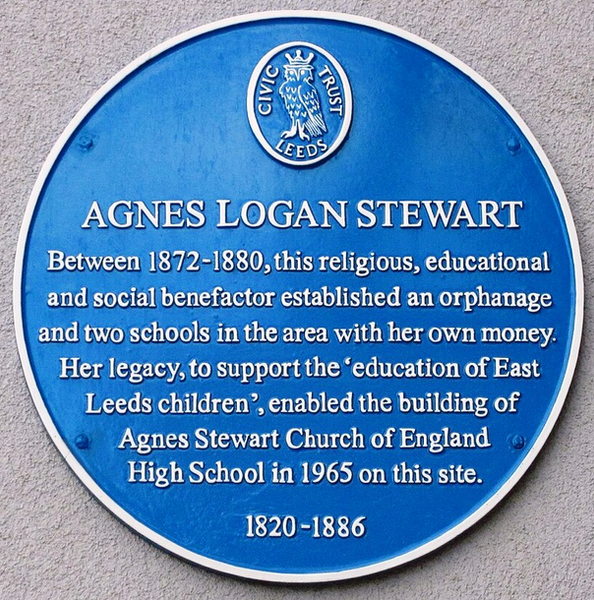
This church and parish owes more to Mother Agnes than we will ever know, as she seems to have taken care that no records of her alms giving and good deeds should be kept. She was a woman of great generosity and deep devotion, as well as of strong character. The children in the Orphanage were well cared for, being warm, properly fed and clothed; not living in luxury but they had trips, treats and Christmas presents, unlike many of the children of the area, who lived in abject poverty. Having already founded the Orphanage she paid for the building of St Hilda’s Boys School on Cross Green Lane and financed the running of the schools; the school for girls and infants had recently been built. She started a Mothers Meeting, a night school for boys who were at work during the day, built a gymnasium for them, ran Confirmation Classes and dispensed material assistance as required. People would go to her with their troubles and she was in every respect a powerful force for good in the area. When strangers came to the door, as they regularly did, asking, “Have you got anything to eat?” none were turned away as she saw in each of them the Risen Jesus. All this vigorous and self-sacrificial work continued in this area for fifteen years. She was entirely focussed, never distracted, always consistent, totally committed, and to the people of the parish at the time it must have seemed as if St Hilda herself was alive and active, working in their midst – or at the very least a living icon of our patron saint.
Mother Agnes, as she was known, died on 30 April 1886, after several years of failing health at the age of 66, the same as St Hilda. Canon John Wylde who had known and supported her since the day of her arrival wrote: The end came unexpectedly at last. It seems as if the day of her death were an epitome of her life. It was on a Friday afternoon, in the Octave of Easter. Easter, telling of life and energy and hope; and the day and the hour speaking of the cross, of which her life ever bore the mark, the deeper as it drew to the end. The Church Times reported: A most beautiful and saintly soul has gone to the rest of God. Like all God’s choicest jewels known only to Him and to just a few on earth, but loved by them with an intensity of love, and valued all the more because she was comparatively unknown. She, in the entire self-sacrifice of her life accomplished by the grace of God wonders of mission work. They say the spectacle of her people’s grief when she was carried to her grave was a sight never to be forgotten.
Wonders of mission work – here, in this parish. How did she do it? In three ways: (1) By personal example; (2) by direct teaching of the Christian Faith, in the schools and also in groups, social and educational, for adults and children; and (3) through active social involvement, seeking to meet those needs which were not being met by statutory provision. Mother Agnes did more than any other individual to build up St Hilda’s church in its early days. She also tried to plan for, and to make provision, for the future.
Her people’s grief – they walked behind the coffin all the way to St James’, Seacroft, as nearby grave-yards were full, and then walked back again, hundreds of them. Who were they? This is not difficult to deduce. Their surnames were: Reynard, Louth, Rocket, Priestley, Yates, Hamill, Wood, Wild, and more, names which appear frequently in our parish registers. The amazing thing is that some of their direct descendents are still around. Her influence lives on, and like that of St Hilda more than a thousand years before, it was so strong and so effective and so entirely positive, that it will never ever be forgotten.
After her death the orphanage was taken over by the Community of All Saints’, who also did pastoral work in the parish, staying until 1938. Successor to Mother Agnes in charge of the orphanage was Sister Serena. When she died she was buried at Whitkirk and it is puzzling that Mother Agnes had not been taken there for burial. The sisters of the Community of the Holy Rood worked in the parish from 1938 until 1965.
When you have spare time, take a walk down Knostrop, and see how totally it has changed. Try to picture where the orphanage was, and the community around. Where the Old Hall was, where the famous artist Atkinson Grimshaw, lived; the New Hall, the Humbug House, the ABC Houses, Jawbone Yard! The late Mr Peter Wood, MA, a former pupil of St Hilda’s School did some very valuable work on preserving the memory of the lost village of Knostrop. The people who drive by and many new residents in Cross Green have no idea of the rich heritage that belongs to this district. In no way can Cross Green be described as ordinary. It is a special place. After visiting Knostrop continue your pilgrimage by going to visit the grave of Mother Agnes at Seacroft. It is clearly marked and easy to find close to the east end of St James’s church. The surmounting cross was damaged by vandals in the 1960s. Take some flowers and offer a prayer of thanksgiving for all that she did.
As we, in our own day and in very changed circumstances, seek to achieve, by the Grace of God, wonders of mission work in this parish, as we try follow her example of serving the community, as we try to promote Christian education and to hand on the Faith that we have received, as we try to plan for the future – may St Hilda pray for us and may St Agnes pray for us.
Stephen Savage